Posts

Showing posts with the label micro tri gloss

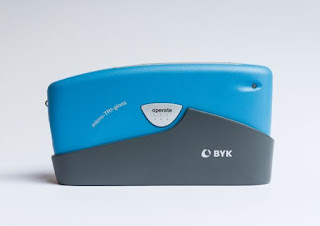
Micro Tri Gloss: How Do you Use a Byk Gloss Meter?
Image
You’ve likely seen gloss meters at paint stores and with industrial equipment sellers — angular devices with a thick needle-like probe sunk into a thick plastic block. When you press the probe against any surface, the meter gives out reading in degrees of gloss, from 0 to 90 or more. For example, if someone said that something needed 20-degree gloss to match the factory coating, they might mean 20 degrees of gloss measured by a micro tri gloss meter .  Here is something you need to know about gloss meters, though: they are often used improperly, giving the wrong results. And not knowing that can cost you thousands of dollars in unnecessary repairs.     The problem is that most gloss meters were not designed to be anything more than a simple scale for measuring total thickness on surfaces. To get the most accurate results for measuring paint, you need a special meter designed specifically to measure gloss on paint.  That’s what Byk has done with their incredible Micro...
Top industrial Coating Inspection Equipment

Image
A coating inspection may happen at any manufacturing facility. One way which is recommended for a simple and efficient application of coatings on products is to use industrial coating inspection equipment. One such equipment is the micro tri gloss meter , which inspects products in nano-scale layers, allowing manufacturers to ensure that their product has the right surface properties before being finalized. Another industrial equipment offered for sale online involves a Micro Vickers hardness test system, a digital device with LCD and Wi-Fi capability that measures collected samples from objects at specified tests. It will also allow the operator to add, update, and edit testing parameters using a smartphone. The micro tri gloss is high-precision inspection equipment that can measure coatings down to 50 nanometers (nm). This can be extremely useful when using coatings on products, such as cell phones; these coatings may be prone to scratches and bumps that could compromise product fun...

Gloss Meter & Its Types

Image
Many individuals and businesses have a gloss meter in their inventory to measure the quality of finishes. The finished product is tested with a gloss meter to check if the paint or varnish has been evenly applied or if the finish is too glossy or not shiny enough. A high gloss will produce a reading on the meter while relatively low readings are usually found on surfaces that have been treated with an anti-glare, no-vinyl, semi-matte, flat paint coating. The gloss meter is equipped with a mirror which reflects light back onto an angled, prismatic surface that deflects it at various angles and into varying lengths of time as it travels through different materials. The surface material can also be made up of several layers to detect multi-layer systems and the gloss meter is placed at an angle of 45 degrees to the surface. A reflected beam of light will reflect off of the surface before it travels back through the gloss meter's prismatic lens and into a receiver aperture hole, allowi...